
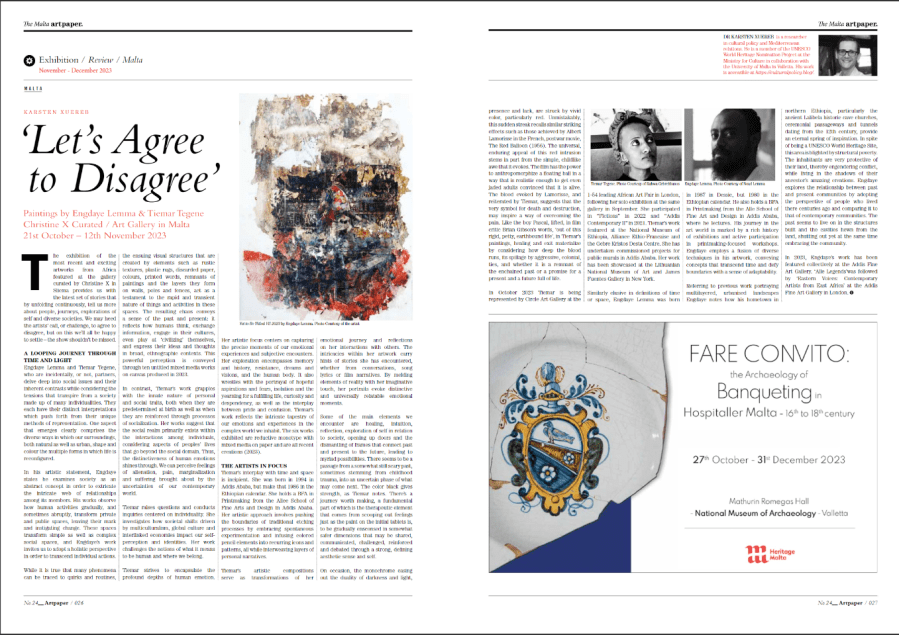
Review of exhibition by Engdaye Lemma & Tiemar Tegene held in Malta at the end of 2023, featured on Artpaper https://issuu.com/artpaper
Christine X Curated / Art Gallery in Malta
The exhibition of the most recent and exciting artworks from Africa featured at the gallery curated by Christine X in Sliema provides us with the latest set of stories that by unfolding continuously, tell us more about people, journeys, explorations of self and diverse societies. We may heed the artists’ call, or challenge, to agree to disagree, but on this we’ll all be happy to settle – the show shouldn’t be missed.
A looping journey through time and light
Engdaye Lemma and Tiemar Tegene, who are incidentally, or not, partners, both delve deep into social issues and their inherent contrasts while considering the tensions that transpire from a society made up of many individualities. They each have their distinct interpretations which push forth from their unique methods of representation. One aspect that emerges clearly comprises the diverse ways in which our surroundings, both natural as well as urban, shape and colour the multiple forms in which life is reconfigured.
In his artistic statement, Engdaye states he examines society as an abstract concept in order to extricate the intricate web of relationships among its members. His works observe how human activities gradually, and sometimes abruptly, transform private and public spaces, leaving their mark and instigating change. These spaces transform simple as well as complex social spaces, and Engdaye’s work invites us to adopt a holistic perspective in order to transcend individual actions.
While it is true that many phenomena can be traced to quirks and routines, the ensuing visual structures that are created by elements such as rustic textures, plastic rugs, discarded paper, colours, printed words, remnants of paintings and the layers they form on walls, poles and fences, act as a testament to the rapid and transient nature of things and activities in these spaces. The resulting chaos conveys a sense of the past and present: it reflects how humans think, exchange information, engage in their cultures, even play at ‘civilizing’ themselves, and express their ideas and thoughts in broad, ethnographic contexts. This powerful perception is conveyed through ten untitled mixed media works on canvas produced in 2023.
In contrast, Tiemar’s work grapples with the innate nature of personal and social traits, both when they are predetermined at birth as well as when they are reinforced through processes of socialization. Her works suggest that the social realm primarily exists within the interactions among individuals, considering aspects of peoples’ lives that go beyond the social domain. Thus, the distinctiveness of human emotions shines through. We can perceive feelings of alienation, pain, marginalization and suffering brought about by the uncertainties of our contemporary world.
Tiemar raises questions and conducts inquiries centered on individuality. She investigates how societal shifts driven by multiculturalism, global culture and global economies impact individuals’ self-perception and identities. Her work challenges the notions of what it means to be human and where one belongs. Tiemar also strives to encapsulate the profound depths of human emotion. Her artistic focus centers on capturing the precise moments of our emotional experiences, delving into individuality, self-awareness, subjective encounters and everyday life. Her exploration encompasses memory and history, resistance, dreams and visions, the human body as well as, on the one hand, the portrayal of both hopeful aspirations and fears, isolation and the yearning for a fulfilling life, curiosity and despondency and, on the other, the interplay between pride and confusion. Tiemar’s work reflects the intricate tapestry of our emotions and experiences in the complex world we inhabit. The six works exhibited are reductive monotype with mixed media on paper and are all recent creations (2023).
The artists in focus
Tiemar’s interplay with time and space is incipient. She was born in 1994 in Addis Ababa, but make that 1986 in the Ethiopian calendar. She is rooted in her background as a printmaker. She holds a BFA in Printmaking from the Allee School of Fine Arts and Design in Addis Ababa. Her artistic approach involves pushing the boundaries of traditional etching processes by embracing spontaneous experimentation and infusing colored pencil elements into recurring icons and patterns, all while interweaving layers of personal narratives.
Tiemar’s artistic compositions serve as transformations of her emotional journey and reflections on her interactions with others. The intricacies within her artwork carry hints of stories she has encountered, whether from conversations, song lyrics or film narratives. By melding elements of reality with her imaginative touch, her portraits evoke distinctive and universally relatable emotional moments.
Some of the main elements we encounter are healing, intuition, reflection, exploration of self in relation to society, opening up doors and the dismantling of frames that connect past and present to the future, leading to myriad possibilities. There seems to be a passage from a somewhat still scary past, sometimes stemming from childhood trauma, into an uncertain phase of what may come next. The color black gives strength, as Tiemar notes. There’s a journey worth making, a fundamental part of which is the therapeutic element that comes from scooping out feelings just as the paint on the initial tablets is, to be gradually ensconsed in somewhat safer dimensions that may be shared, communicated, challenged, reinforced and debated through a strong, defining aesthetic sense and self.
On occasion, the monochrome easing out the duality of darkness and light, presence and lack, are struck by vivid color, particularly red. Unmistakably, this sudden streak recalls similar striking effects such as those achieved by Albert Lamorisse in the French, postwar movie, The Red Balloon (1956). The universal, enduring appeal of this red intrusion stems in part from the simple, childlike awe that it evokes. The film has the power to anthropomorphize a floating ball in a way that is realistic enough to get even jaded adults convinced that it is alive. The blood evoked by Lamorisse, and reiterated by Tiemar, suggests that the very symbol for death and destruction, may inspire a way of overcoming the pain. Like the boy Pascal, lifted, in film critic Brian Gibson’s words, ‘out of this rigid, petty, earthbound life’, in Tiemar’s paintings, healing and exit materialize by considering how deep the blood runs, its spillage by aggressive, colonial, ties, and whether it is a remnant of the enchained past or a promise for a present and a future full of life.
In October 2023 Tiemar is being represented by Circle Art Gallery at the 1-54 leading African Art Fair in London, following her solo exhibition at the same gallery in September. She has previously been featured in group exhibitions such as “Fictions” in 2022 and “Addis Contemporary II” in 2021. Tiemar’s work has also featured at the National Museum of Ethiopia, Alliance Ethio-Francaise and the Gebre Kristos Desta Centre in Ethiopia. She has undertaken commissioned projects for public murals in Addis Ababa. Her work has been showcased at the Lithuanian National Museum of Art and James Fuentes Gallery in New York.
Similarly elusive in definitions of time or space, Engdaye Lemma was born in 1987 in Dessie, but 1980 in the Ethiopian calendar. He holds a BFA in Printmaking from the Alle School of Fine Art and Design in Addis Ababa, which he completed in 2007. He contributes to the academic field by serving as an assistant lecturer at the same institution. His journey in the art world is marked by a rich history of exhibitions and active participation in printmaking-focused workshops. Engdaye employs a fusion of diverse techniques in his artwork, conveying concepts that transcend time and defy boundaries with a sense of adaptability.
Referring to previous work portraying multilayered, urbanised landscapes Engdaye notes his hometown in northern Ethiopia, particularly the ancient Lalibela historic, religious cave churches, ceremonial passageways and tunnels dating from the 12th century, provide an eternal spring of inspiration. Nowadays, this area is blighted by structural poverty. The inhabitants are very protective of their land, sometimes engendering conflict, while living in the shadows of the amazing buildings created by their ancestors. Engdaye notes he’s keen on exploring the relationship between past and present communities by adopting the perspective of people who lived there centuries ago and compare it to that of contemporary communities. He suggests that the only remnants of the past are restricted to the the structures built, and the cavities hewn from the land, shutting out yet at the same time embracing current populations.
In the current year, Engdaye’s artistic endeavors have been featured in two group exhibitions hosted by the Addis Fine Art Gallery. ‘Alle Legends’, took place at the Addis Fine Art Gallery in Ethiopia from January to April. Subsequently, his work was showcased in ‘Eastern Voices: Contemporary Artists from East Africa’ at the Addis Fine Art Gallery in London during June and July.

 Cultural Policy
wow!! 2320 Years of EU membership & cultural policy in Malta
LikeLiked by 1 person