
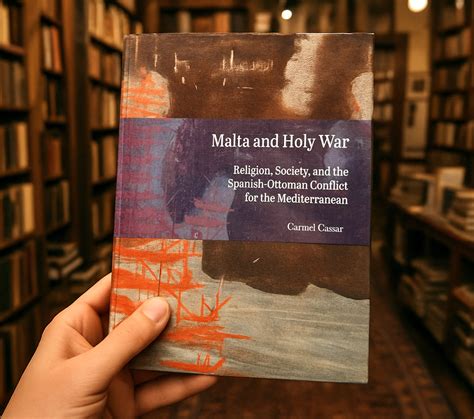
The text below allowed me to provide a brief reflection on Prof Carmel Cassar’s latest publication: Malta and Holy War: Religion, Society and the Spanish-Ottoman Conflict for the Mediterranean, published by Kite Group (2025).
22nd January 2026, Notarial Archives, Valletta
I’d like to start at the beginning – as sung by Sister Maria in The Sound of Music, the beginning is a good place to start.
And I’d like to focus on the preposition ‘for’ in the title, which attracted my interest: ‘Religion, Society, and the Spanish-Ottoman Conflict for the Mediterranean’ suggests a struggle which aimed at gaining the upperhand, and control, over the whole region, suggesting an all-or-nothing approach. The text suggests that while this may have been the approach adopted by the contenders for the Mediterranean, in reality the struggle for power in the Mediterranean was (and still is) split down many slender areas of influence.
The address of the first part of the book, starting from chapter one, reinforces the idea of a straightforward struggle between the Western Christian forces on the one hand, and the Ottoman and other Muslim forces on the East and the South. However, my impression is that Professor Cassar takes this nominal approach to undercut this particular narrative, and by doing so draw our attention, through thorough research and references, to a picture that was (and still is) much more multifaceted and splintered.
One of the most striking examples of this complex picture is the long-standing, albeit not always reliable, alliance between the French forces and Ottoman political and military powers, against the Spanish Habsburgs. Another example of such cross-religious and political rivalry is provided by, once again, the Ottomans, and Venice, in the wake of economic, scientific and cultural rapprochements engaged in by Suleiman the Magnificent and the Doge, as narrated by Christopher de Bellaigue in The Lion House published in 2023 and captured a number of times by Nobel prize winner Orhan Pamuk.
Throughout Professor Cassar’s text, the explicit and underlying reference to the research carried out by Horden and Purcell at the turn of the millenium brings to mind the seminal collection of papers edited by W. V. Harris and published in 2005, Rethinking the Mediterranean, in which Horden and Purcell react to the reviews published till then on their The Corrupting Sea. Together with the matter of many Mediterraneans raised in this collection, and the many struggles happening in micro-regions of the wider space, one other matter was focused on in depth: namely, that of whether, alongside discussing how many Mediterraneans existed, and whether they could be reconciled into one – depending on the context and contest assessed – there was a Mediterranean at all.
Incidentally, at a recent seminar held by il-Kamra tal-Periti and UMRA, the Mediterranean union of architects, Dr Ray Bondin, active in UNESCO heritage fora for a good number of years, asked participants to consider whether the very Mediterranean itself actually existed.[1] But I’d like to come to a little more of that before concluding, in a few minutes’ time.
Professor Cassar’s analysis considers the different ways in which the Mediterranean was made to function, depending on the aims and functions of the various rivals in this wide arena. Reading his research brought to mind the bridge, the wall and the mirror metaphors for the Mediterranean that Christian Bromberger applied to the region, and its history, in 2005.[2] In applying these different concepts, and the related practical models of behaviour, to the way the community members of the three monotheistic systems that emerged from the Mediterranean interacted within their respective groups and with one another, Bromberger speaks of ‘complementary differences.’ These complementary differences reflected certain clear distinctions, while also allowing for subtle influence to take place.[3]
In assessing the work of Bromberger, Dionigi Albera notes that Judaism, Christianity and Islam formed a system of contrasts through a coming together of reciprocal oppositions.[4] Albera notes that while balancing proximity with diffidence, the different groups of brethren often shared the same spaces, meeting and observing one another. While each community behaved as a, I quote, ‘besieged citadel,’ monitoring external threats and potentially treacherous behaviour internally, the, I quote, ‘ostentatious separatism,’ followed cultural forms that, in their strictness, belied the spillovers, or débordements, that forged deep, influential and long-standing relations across and within different communities.
To begin to conclude, it is important to say that Professor Cassar balances the focus on the micro level with the wide angle, capturing sociological and cultural particularities within a broad canvas. An example of this narrative that connects different levels is the battle of Lepanto, that took place in 1571. This episode is not only accompanied by a relative waning of Ottoman influence and threat, and the ensuing decline of great naval battles engaged in by Christianity. In 1988, Francois Fourquet captured the symbolic meaning of Lepanto to Braudel, whose perspective in this text is pervasive: in Braudel’s writing, Lepanto evokes in us readers a dramatic emotion. The Turks and the Spanish battle one another, but we, as spectators, know that the real drama is by now happening elsewhere, namely in the Atlantic. Since the turn of the century, Antwerp has become the centre of enterprise for the Spanish Empire, and in Braudel’s own cruel assessment, while the French and the Spanish fight over cities, places and terrain, the Dutch and the English have seized the world.[5]
However, as is suggested in Professor Cassar’s text, Braudel’s idea of a Mediterranean that somehow still matters, albeit differently, stems from its sense of disparate unity. Ironically, rather than centrifugal, the direction of economic, social and cultural influence has become centripetal, therefore from the outside in, with the Mediterranean gaining importance as an intermediary among three continents, as described by Maryline Crivello in a recent reflection on Braudel’s continued significance towards the Mediterranean.[6]
And like Braudel, Professor Cassar’s insights throw further light on the many crevices in the field of research into the history of the Mediterranean, thereby nourishing his readers with the potential for further understanding and interpretation.
[1] https://kamratalperiti.org/event/cultural-resilience/
[2] Christian Bromberger, ‘Le pont, le mur, le miroir. Coexistence et affrontements dan le monde méditerranée’, Thierry Fabre & Emilio La Parra (dir.), Entre Europe et Méditerranée. Paix et guerres entre les cultures, Actes Sud, 2005, 115-138.
[3] A similar observation is expressed by Ivo Andrić, also a Nobel winner, in ‘Letter from the Year 1920’ where the image of the Sarajevan clock towers serving different religious communities while marking divergent time is used to express cohabiting divisions.
[4] Dionigi Albera, ‘Les religions en Méditerranée, entre partition et partage’, Julie Benetti & Nicolas Molfessis (dir.), La Méditerranée, Pouvoirs n.183, Seuil, 2022, 65-76.
[5] It is worth noting that in later texts Braudel revisited this perspective by reflecting on how the spice and pepper trade through southern African routes and the trade of silver from the Americas centring on Genova revived the Medtiterranean commercial space.
[6] Maryline Crivello, ‘Relire La Méditerranée de Braudel aujourd’hui’, Julie Benetti & Nicolas Molfessis (dir.), La Méditerranée, Pouvoirs n.183, Seuil, 2022, 5-14.

 Cultural Policy