
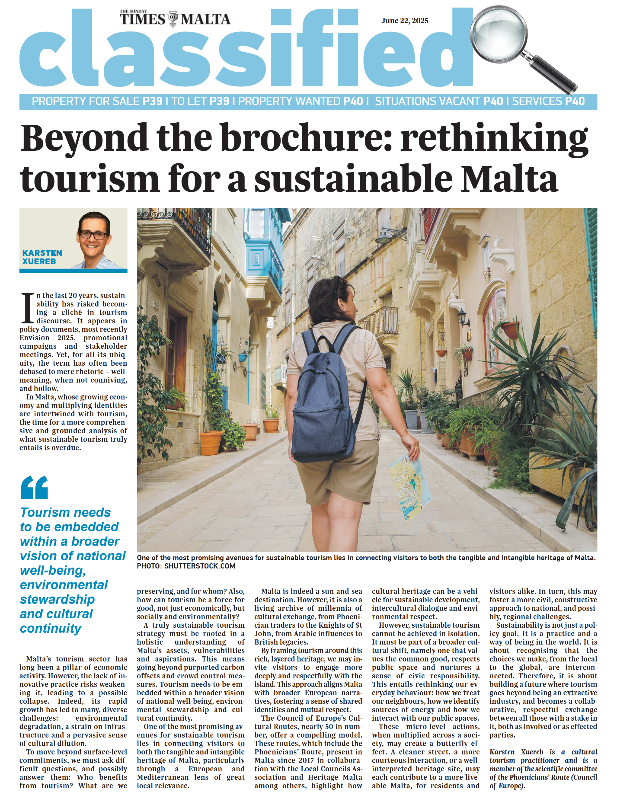
In the last twenty years, sustainability has risked becoming a cliché in tourism discourse. It appears in policy documents, most recently Envision 2025, promotional campaigns and stakeholder meetings. Yet, for all its ubiquity, the term has often been debased to mere rhetoric — well-meaning, when not conniving, and hollow. In Malta, whose growing economy and multiplying identities are intertwined with tourism, the time for a more comprehensive and grounded analysis of what sustainable tourism truly entails is overdue.
Malta’s tourism sector has long been a pillar of economic activity. However, the lack of innovative practice risks weakening it, leading to a possible collapse. Indeed, its rapid growth has led to many, diverse challenges: environmental degradation, a strain on infrastructure and a pervasive sense of cultural dilution. To move beyond surface-level commitments, we must ask difficult questions, and possibly answer them: Who benefits from tourism? What are we preserving, and for whom? Also, how can tourism be a force for good, not just economically, but socially and environmentally?
A truly sustainable tourism strategy must be rooted in a holistic understanding of Malta’s assets, vulnerabilities and aspirations. This means going beyond purported carbon offsets and crowd control measures. Tourism needs to be embedded within a broader vision of national wellbeing, environmental stewardship and cultural continuity.
One of the most promising avenues for sustainable tourism lies in connecting visitors to both the tangible and intangible heritage of Malta, particularly through a European and Mediterranean lens of great local relevance. Malta is indeed a sun-and-sea destination. However, it is also a living archive of millennia of cultural exchange, from Phoenician traders to the Knights of St. John, from Arabic influences to British legacies.
By framing tourism around this rich, layered heritage, we may invite visitors to engage more deeply and respectfully with the island. This approach aligns Malta with broader European narratives, fostering a sense of shared identities and mutual respect. The Council of Europe’s Cultural Routes, nearly 50 in number, offer a compelling model. These routes, which include the Phoenicians’ Route, present in Malta since 2017 in collaboration with the Local Councils Association and Heritage Malta among others, highlight how cultural heritage can be a vehicle for sustainable development, intercultural dialogue and environmental respect.
However, sustainable tourism cannot be achieved in isolation. It must be part of a broader cultural shift, namely one that values the common good, respects public space and nurtures a sense of civic responsibility. This entails rethinking our everyday behaviour: how we treat our neighbours, how we identify sources of energy and how we interact with our public spaces.
These micro-level actions, when multiplied across a society, may create a butterfly effect. A cleaner street, a more courteous interaction, or a well-interpreted heritage site, may each contribute to a more liveable Malta, for residents and visitors alike. In turn, this may foster a more civil, constructive approach to national and possibly regional challenges.
Sustainability is not just a policy goal. It is a practice and a way of being in the world. It is about recognising that the choices we make, from the local to the global, are interconnected. Therefore, it is about building a future where tourism goes beyond being an extractive industry, and becomes a collaborative, respectful exchange between all those with a stake in it, both as involved or as effected parties.
Dr Karsten Xuereb is a cultural tourism practitioner and is a member of the scientific committee of the Phoenicians’ Route (Council of Europe).
Also available here: https://www.pressreader.com/malta/the-sunday-times-malta-1805/20250622/282024743238313?srsltid=AfmBOoq7XEZMKhk09b2v6NdyoVasOugl_iiWMM1FHf_V8aVKnmNaQY7b

 Cultural Policy
Prosit tassew, Karsten! Ktibt artiklu għaqli, serju u mirqum ħafna. Jinkuraġġixxi ħsieb profond aktar milli reazzjonijiet superficjali. Tabilħaqq meħtieġa dit-tip ta’ vuċi, speċjalment f’dawn iż-żminijiet. Bravu!
https://www.um.edu.mt/
Dr Jacqueline Żammit | Senior Lecturer
B.Ed. (Hons.) (Melit.), M.A. Qual. (Melit.), M.A. (Melit.), Ph.D. (Melit.)
Coordinator in Maltese Pedagogy
Associate** (handling)** Editor, Springer Nature, Humanities and Social Sciences Communications
Faculty of Education
Department of Languages and Humanities in Education
Faculty of Media & Knowledge Sciences, Room 311
+356 2340 3148 Profile https://www.um.edu.mt/profile/jacquelinezammit https://scholar.google.com/citations?user=nyFBP3IAAAAJ&hl=en&authuser=1
LikeLiked by 1 person
An interesting read, thank you!
LikeLike