
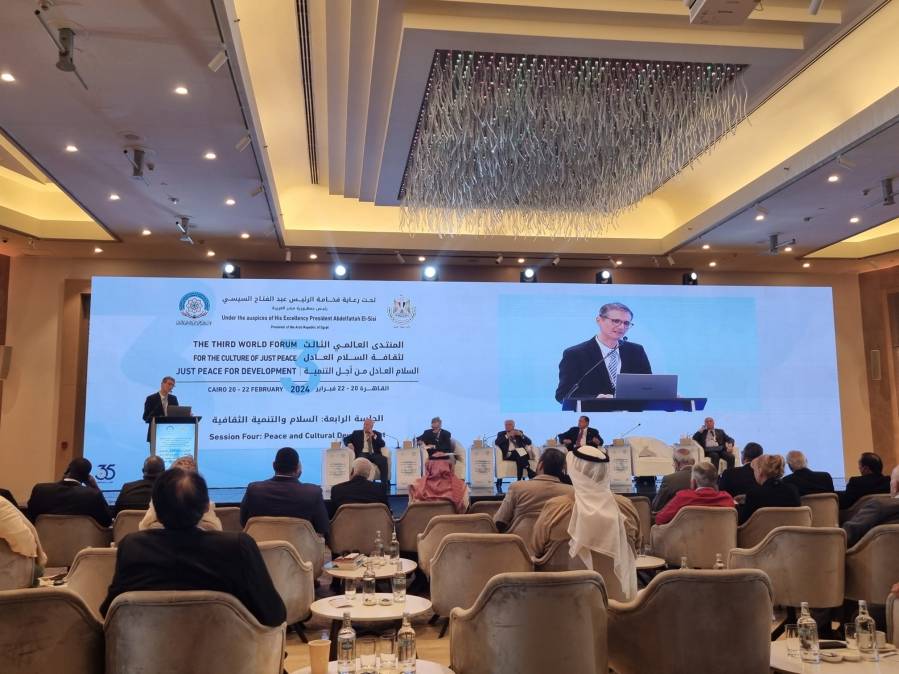
Between 20 and 24 February 2024 I was invited to participate at the Third World Forum for the Culture of Just Peace organised by the Abdulaziz Saud Al-Babtain Cultural Foundation in Cairo held under the auspices of His Excellency President Abdel Fattah EI-Sisi, President of the Arab Republic of Egypt, in collaboration with the Egyptian Supreme Council of Culture. This is the summary of the paper published in the proceedings. Should you wish a copy of the full paper contact me on karsten.xuereb@um.edu.mt. Thanks to the Centre for the Study and Practice of Conflict Resolution at the University of Malta for the opportunity of exchanging experiences and perspectives.
The Dialectics of Heritage & Modernization addressing Peace & Cultural Development in the Mediterranean
Summary
This paper addresses the dialectics of heritage and modernization by providing an analysis of key tensions inherent to the relationship between these two expressions of humanity. It does this to highlight the historical context of the diverse ways in which writers, historians and critics have perceived this dynamic.
This assessment provides the reader with ample tools with which to understand significant developments that are pertinent to peace and cultural development in the Mediterranean. The first half of the text refers to a variety of perspectives provided by different writers across various geographical spaces and periods. The second half grounds these observations in an assessment of current practice in the field of intercultural dialogue and virtuous cultural and economic development. The Mediterranean provides the context for discussion and enables the elaboration of a set of conclusions and reflections that aim to inspire further research and positive practice in the field of peace and cultural development.
In the first section, Part I addresses aspects of modernization that shape our understanding of heritage. It does so with reference to examples of both Eastern and European twentieth-century thought, in particular to D. P. Mukerji, T. S. Eliot, Theodor Adorno and Pier Paolo Pasolini. Part II confronts issues at the root of cultural conflict and gaps in understanding within the framework of important scholarship, especially that of Iain Chambers, assessing significant developments in Mediterranean history. Part III refers to a set of theoretical frameworks related to Fernand Braudel and spanning the East and West of the Mediterranean, as in the work of Taha Hussein, with which to assess contemporary ways of thinking and practice, with an aim to sustain better forms of social relations.
In the second section, Part IV considers a particular example of best practice that may act as inspiration in addressing challenges arising from the tensions between heritage and modernization with an impact on further intercultural dialogue as a contributor to peace and cultural development.
In conclusion, Part V sets out a series of recommendations, concluding thoughts and reflections with which to sustain further positive research and practice in the Mediterranean. This paper considers schools of though shaping perceptions and practice of heritage that manifest themselves during the end of the nineteenth and the twentieth centuries. This span of time provides an epoch of important reflection on matters related to the living past and the ways in which heritage informed contemporary perspectives on the present and the future. As is the case with other Eastern thinkers, as well as some Western ones, Amr Amin Elsherif is evoked to consider how perspectives of the world stemming from outside Europe relied too significantly on the liberal framework developed by the West. Among the main thought structures that still need challenging in this field, and therefore focused on in this paper, are the concepts of development, progress, collaboration and intercultural dialogue.
This text concludes by offering a series of reflections and suggesting a set of recommendations that may support further research and inform practice in the field of Mediterranean dialogue and cultural development.


 Cultural Policy